Happy Birthday Luna!

March 6, 2011

One of my earliest posts spoke to our coming loss of Boomer.  We put her down a few days later, September 12, 2009.

Our plans around my sabbatical in Winter 2010 suggested to us that we should wait for our next dog.  And so we did.  But in late spring we welcomed Luna, a nine-week old yellow lab, into the family.  At midnight, Luna turns one.  And when last weighed is now 61 pounds of energy.

Luna is a sweet, sleek, athletic yellow lab.  Tobae hadn’t had a puppy before, but I had, and all other things equally she has been an excellent pup (this is a gentle way of saying Tobae has sometimes been pretty chagrined with her behavior).   She has become an accomplished mountain dog, especially fond of snow.  For students of genetics of yellow labs she has a pink nose, but is not a “Dudley”.  (And Tobae, *stop* calling her Pinky.)

Some highlights of her first year:

Visiting the “family mountain” Dickerman Mountain (a traditional Mother’s Day hike, except for our two years skiing Mount St. Helens)

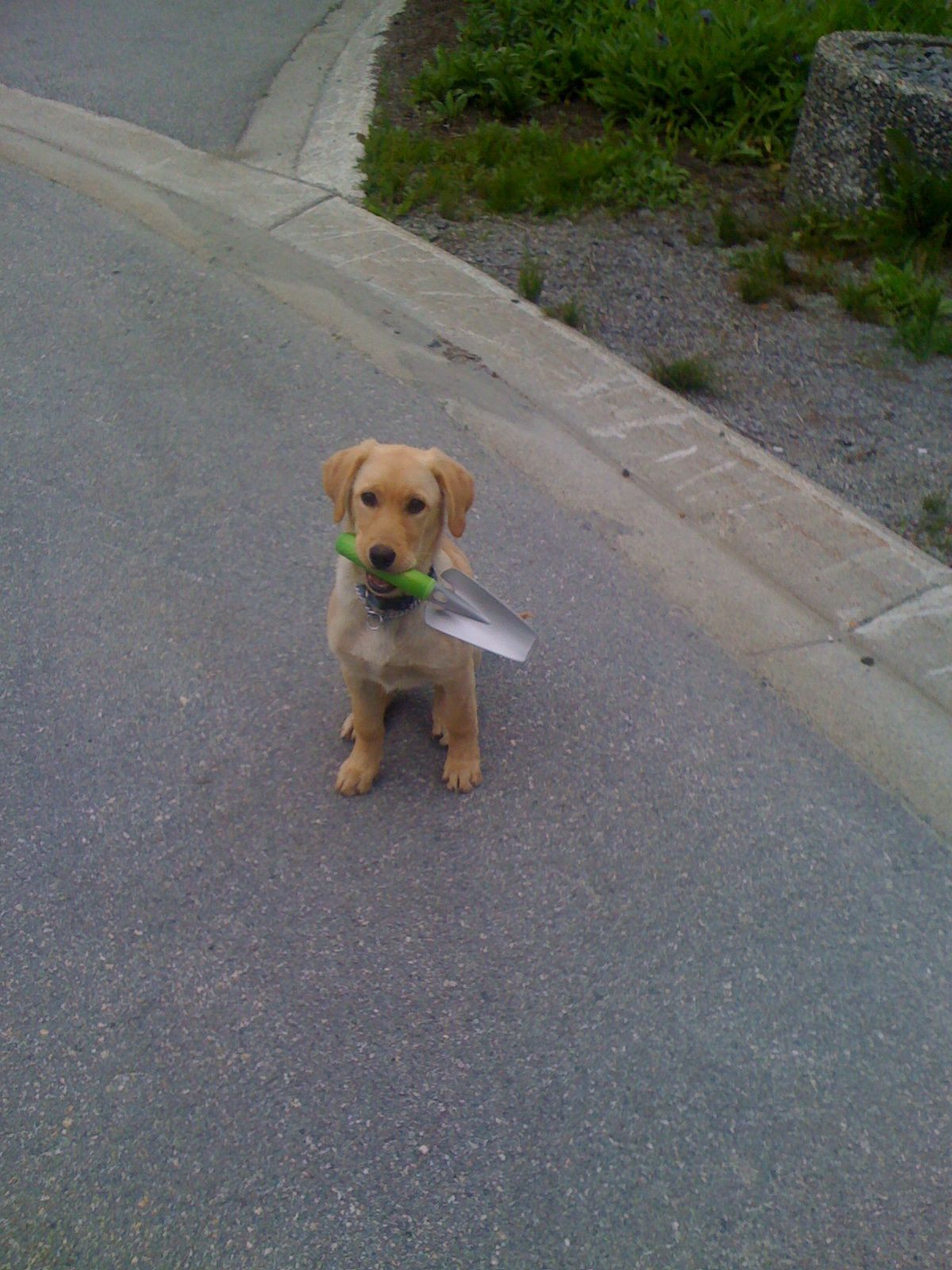
With her pooper scooper, July 4 weekend at Whistler:

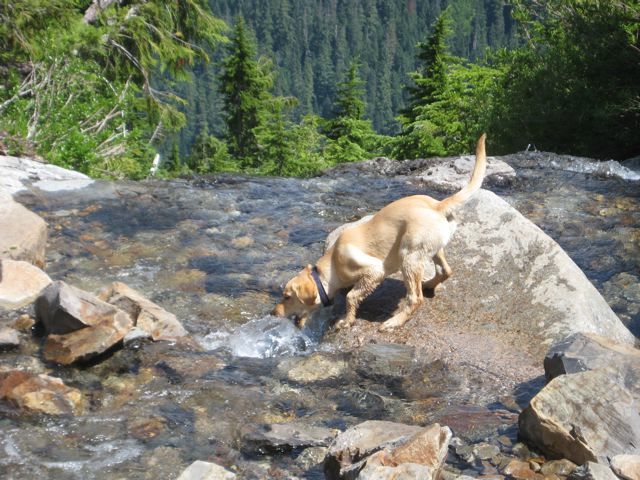
Along the trail to Gothic Basin in Summer 2010 (on a trip to begin to spread Boomer’s ashes in the mountains she loved):

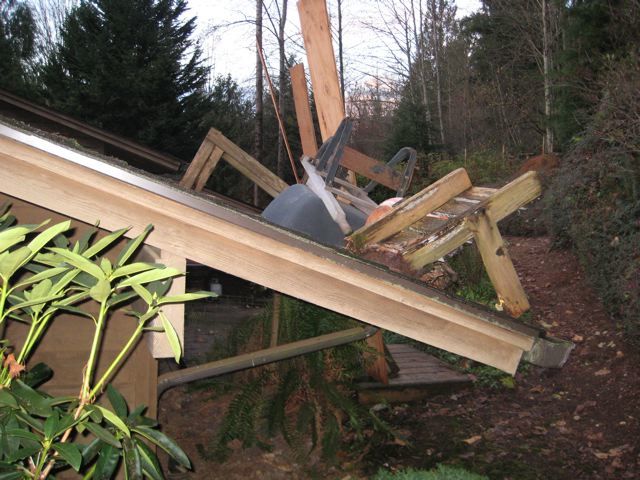
Our “white trash” fortifications to prevent her from getting onto the roof and chewing up the roof jacks:

Video of her backcountry ski trip with Tobae, Sean and Sean’s dog Amico.  Tobae is holding the dogs up, Sean has skied down to take video.  (Whenever we play the video, Luna perks up when she hears Sean’s voice)

The low light of the year was son Mark, Facebook employee, insisting that a dog cannot have a Facebook account.  But as I read the terms of service, she will be eligible as soon as she is 13 (dog years!).  I really don’t care that dogs don’t fit the Facebook business model.

[Update, 3/7, 5:45 pm.  A Facebook page for a dog (not a profile!) courtesy of son Mark…]

Tobae is coming to see that Luna is “The Best Dog in the World”!


30 Years of Husky Football

March 5, 2011

After 30 years as a Husky football season ticket holder, I’ve decided not to renew my tickets.

I like college athletics.  I competed in Division 3, as have both my sons.   I like to watch football.   That was something I did as an undergraduate at Caltech (won one game), something I couldn’t as a graduate student at UCSD (they had abandoned football after that loss), and didn’t at MIT as a postdoc.  Arriving at UW in 1981, brought new opportunity!  And certainly Division I football is the front porch of UW, a catch phrase popularized by past President Mark Emmert and now adopted by Interim President Phyllis Wise (though I think they would be hard pressed to show the connection directly by analysis of donor interest in academics, athletics or both).

Three problems for me:

One problem is that our athletic front porch is exceptionally ugly right now.

1) I know and like Athletic Director Scott Woodward.  I was very disappointed to see him move to Intercollegiate Athletics simply to fire an 0-7 football coach.  His expertise was much more valuable in Gerberding Hall.  Two years later the question of whether he is a particular good AD is argued.  And so galling is the last day contract extension as Mark Emmert moved on.  And as reported in the Seattle Times, the unchallenged reasoning is laughable:

Emmert said he wanted to ensure that the position was solidified before he left UW.

(By the way Seattle Times, is there some reason that you don’t link to the underlying documents that you have obtained by a public records request so that a reader can do an independent analysis?)

2) And a good thing that contract was solidified, so that just a month later when embroiled in foot-in-mouth controversy, Interim President Phyllis Wise had her fiscal hands tied and firing Woodward would just create more angst and red ink.  Perhaps her public chiding of Woodward was more around anger over the actions of her predecessor?  And the chiding:  a university president doesn’t recognize that open discourse, even when embarrassing, is a core value of the academy?

3) The Husky Stadium renovation has been scaled down, but in no way in line with safety issues alone.  Do we need $300 million from the regional economy moving in this direction?  What is wrong with Qwest Field?  Tradition is argued.  So students are moving to the end zone?  See my second problem below for related commentary.

4) Scoreboard Baby.  Well researched about an era with a weasel football coach.  UW administration shares culpability, but I don’t see legitimate change occurring in response.  Prosecutorial discretion or not, the basketball rape scandal this year is a measure that from the top down, UW doesn’t care about its own reputation or credibility.

My second problem is schedule frenzy.  What happened to 12:30 p.m. games that lasted a little over three hours?  Game time is now most often announced on the Monday eleven days ahead.  How is one to plan life?  And games starting as late as 7:30 p.m.  Ever entered the north gates near the Dempsey during one of these late starts?  Nothing worse than an already quite drunk crowd.  Pragmatically I must shed tickets and getting face value (which varies too little across the stadium) is difficult.

My third problem is the loss of the track.  The Pac-12 championship will never return to Seattle…

My solution is simple.  Just buy re-sold tickets on StubHub for the games I can actually attend.  Thinking back to the economic model for stadium renovation there should have been much more concern in approving financing around this new reality.  The frustration of season ticket holders isn’t just a losing team.


Duke Snider, 1926-2011

February 27, 2011

I grew up in Southern California.  My first trip to a major league game was one of the two 1959 all-star games, played in Los Angeles Coliseum, just before I turned 8.   Don Drysdale started for the NL.  The game ended with Wally Moon striking out.  The Coliseum was not well suited for baseball, we must have been 550′ or so from home plate.

And a Dodger fan I became.  (I go with the flow and so since then Giants when in northern California, Padres when in San Diego, never quite bonded with Boston, and eventually the Mariners in the AL and the Giants in the NL).

Some awesome players and awesome teams.  Including Duke.  And so losing Gil Hodges to the expansion Mets in 1962 was a blow, but the trade of Snider in 1963 to the Mets was a real kick.  I recognize now that his career was in decline and four decades later we certainly know baseball is a business.  But his May 22 home run against the Dodgers sticks in my mind: first at-bat against them, Drysdale pitching for the Dodgers.  Take that O’Malley!  (Dodgers won 7-3).  (Again appreciative of baseball-reference.com to remind me of the details.)

Thanks Duke.  The golden age of baseball for me…

(An update 2/27 at 16:09.  Reader Ron’s comment is of course right, the move of the Dodgers and Giants was a much more real kick.)


Charitable Administrativia

February 26, 2011

For the past several years I have served on the board of a 501(c)(3) charitable organization, American Friends of Whistler.  We provide opportunity for people spending significant time in Whistler to support charitable needs in our second community and through our annual “Inside Scoop” event let our supporters know about what is happening in the municipality and on the mountain.

With my new free time, I am taking on some new duties.  One is to manage our web presence and the other is to become treasurer and learn the intricacies of Form 990-EZ.

Thursday I spent an amazingly long time at the downtown Seattle branch of Wells Fargo Bank with the outgoing treasurer doing transfer of signature authority.  It is not simple like the last time I was physically in a bank when there was really a signature card.  Now everything is electronic.  I am not sure how they can tell if a real signature looks like the poor imitation rendered on a digital signing pad.  But I was able to sign over and over and over again, this form and that form, and enter a PIN three times.  A little over a hour later, all done.  The young banker was nice enough, but it is difficult to be convinced that these processes are at all efficient.

At the intersection of web presence and tending donations is thinking about accepting credit cards.  We have nearly exclusively received checks.  Occasional transfers of stock.  Should we accept credit cards?  Would giving go up?  Or would the costs of accepting credit cards simply not be worth the effort?

And so started my adventure in puzzling out our options.

Straightforward and in our control would be to establish a PayPal account.  As a 501(c)(3), they would take 2.2% + 30¢ per transaction ($2.50 on a $100 dollar donation).  At present our administrative expenses are ~2.4% (we are run by volunteers) and so this seems like a big number, but realistically we would anticipate large donations by check and so it might add a couple of tenths of a percent to administrative expense.  This might be the right pathway.

But there are two families of alternatives that avoid incurring a direct administrative expense that shows up in a 990, at least in ours.  One family is GuideStar/Network for Good.  From the GuideStar site one channels funds to Network for Good which is a 501(c)(3) itself.  They issue a receipt for a $100 deduction.  They would send us $95.25, taking 4.75%.  If one goes straight to Network for Good and makes a $100 donation to us, we receive $100.  But you need to give them $105 for that to happen, and they encourage you to give $110 or $115.  By either path, funds could be immediately transfered to our bank account.  The other family is American Express/JustGive.  The American Express option requires an American Express card, but a $100 donation yields $97.80 to us.  (And with my American Express card, I’d get 100 miles).  Going directly to JustGive, a $100 donation will yield $97, but they encourage an additional optional donation directly to them.   Funds received in a month are sent by check on the 10th of the next month.  None of the money disappearing into their 501(c)(3) coffers are an administrative cost to us.  My overall impression is  a lack of transparency around the overall process; while there are FAQs from which I extracted all of this information,  direct disclosure would seem appropriate.  In the absence of direct disclosure, I visited GuideStar to retrieve the 990 for both Network for Good and for JustGive.  Where does the extra money go?  Network for Good does not have a 990 for 2009 (what’s up with that) so I downloaded the one for 2008. Scale ~$70M of charitable grants.  Seven employees with salaries over $100k. Administrative expense about 10%.  JustGive in 2009.  Scale ~$28M of charitable grants.  CEO is paid $62,000 per year.  Administrative expense about 7%.  So perhaps JustGive is worthy of consideration?

Perhaps the most interesting nugget is that without us doing anything, you can donate to American Friends of Whistler right now by any of these paths!  Really!  Just search for American Friends of Whistler at GuideStar or Network for Good or American Express (Members Give is the service mark) or JustGive.  Thanks for your support, but supporter beware.


Caltech Basketball Conference Loss Streak Broken!

February 23, 2011

Big news this week is the Caltech win over Occidental, breaking a string of 310 basketball losses in SCIAC league play dating  to 1985.  Widely covered in the national print, television and radio.

Each of the Caltech teams has similar challenges.  Son Mark played soccer for three years and experienced four wins.  I played baseball for a short while and we were in a streak of some sort.  I see in the NY Times article today that the present baseball team is on a 412 game conference slide.  Football is long gone from Caltech, but I have memories of our California Boulevard bonfire in celebration of what may have been the last win, circa 1972.  (Ironically UCSD had abandoned football upon my arrival in 1973, the victim of that loss.)

This should bring a revival of interest in the documentary Quantum Hoops which chronicled how close the team came in 2006 to breaking the streak (and made me aware that the last conference win was over a Pomona-Pitzer team coached by Gregg Popovich and that my undergraduate advisor Fred Anson was considered the best Caltech basketball player ever).  Dean Oliver, a late 80s point guard for the Beavers, became a statistical wizard for the Seattle Supersonics and is now with the Denver Nuggets.  He is known for his book “Basketball on Paper”.  And foremost I’m a huge fan of Fred Newman, a player in the 50s and later an assistant coach who holds the record for free throws made in 24 hours (20,371) and who drained 88 in a row blindfolded.  (My personal record is 88, without blindfold.)

Secant, cosine, tangent, sine…logarithm, logarithm, hyperbolic sine…3 point 1 4 1 5 9…slipstick, sliderule, tech, tech, tech.  Go Beavers!


Wine Country II

February 21, 2011

I don’t plan to totally recreate the ensuing years of winery tastings, visits and tours.  Some will appear in time.  For now just last Friday (which will contain some historical threads).

Son Daniel was due at Oakland International at noon, but his plane was delayed by suspension of flight operations with President Obama’s arrival to visit Intel in Hillsboro, Oregon and so we were running about a hour late.  But the essence of the afternoon was just two stops, the first on the Silverado Trail at Paraduxx and the second in downtown Napa at Vintners Collective.

Paraduxx is one of the Duckhorn owned wineries.  My oenophile colleague John Baross knows Dan Duckhorn, who established Merlot in Napa Valley.  For many years it was a by (rare) appointment visit, but perhaps a decade ago they built at wonderful tasting facility and I started to visit.  About the same time Paraduxx was created as to not dilute the brand when experimental wine making was started after the company purchased a vineyard of Zinfandel on Rector Creek (just to the north of Stags Leap District and south of Mumm Napa).

My first visit to Paraduxx was on a AGU Week (aka mid December) Friday, the scouting tour for the next year “lab group” wine trip.  About five years ago, it was a beautiful (for a Seattleite) afternoon and all three tasting room staff were amazed that I chose to sit on the deck in the lows 50s.  I was the only one tasting anywhere indoors or out.  I very much like the tasting for it offers a vertical of Paraduxx (~2/3 Zin ~1/3 Cab Sauv; a “Californian Super Tuscan”) with three vintages capped by the most recent release and one more wine (more on this), served with crackers and two cheeses.  Riedel O “stem”ware.  Served together so you can  go back and forth among the wines.  My server/host, Dan, was a retired local and as we conversed I learned that I “knew” his grandfather, who was the caretaker of the Vallejo watershed north of my parents:  “you boys get out of here” was often heard as we went hiking in the hills.

Tobae, Daniel and I arrived late for our appointment (not a big deal on winter weekdays, but do visit the web site and reserve in advance at busy times of year).  My first server/host Dan was again our server host!  We three shared the current “essentials” and “enhanced” tastings.  The components had changed since my last visits in December 2010 as the 2008 releases were out.

First Course: Parajaxx White Blend 09 (very good at the price point, Viognier based, shipped a case home)

Essentials: Parajaxx Red 08 (Zin and Cab Franc) and 06, 07, 08 Paraduxx.  The Parajaxx was good but not the best wine we tasted.  The Paraduxx 06 is bland and I will be glad to see it go.  Tobae liked it; Daniel has a fine palette like mine! 07 is shaping up just fine.  08 shows lots of promise.

Enchanced: Anchored by Paraduxx 08 with Postmark (Paraduxx single vineyard blends) 08 from Rector and Howell Mountain Vineyards.  The Rector was a wonderful wine, but the price point way too high.  None of us thought the Howell Mountain stood up (particularly painful for me as I love the fundamentals of Howell Mountain zin fruit).  A new blend (60 cab sauv,  40 zin) called Reflection did nothing for us; my suggestion to Paraduxx: don’t repeat in this direction.  Canvasback (Syrah based) is out of the box for Paraduxx: a good wine but many better values in Syrah world.

Extended Tasting: We greatly appreciate Dan serving us  Goldeneye (the third Duckhorn company) Pinot Noir .  But even more appreciated was a Goldeneye unreleased wine with heavy smoke from the 2008 Mendocino forest fires.  The nose was campfire, but I can imagine many food courses going very well.  Very much enjoyed this quite unusual wine.

This is one of the best tastings I know in Napa Valley, a rare opportunity to really explore vintage and terroir.  Like all tastings in Napa Valley, these are wine restaurants drawing profit from the tasting fee…only buy wine you like at realistic price points.

Thanks Dan!

—-

Then to my anchor favorite, Vintners Collective in downtown Napa.  If I am remembering correctly, the same day I first visited Paraduxx, I visited Miner Family (worth visiting).  As is my custom I find new places by asking “where should I go next”.  This is often tainted by formal marketing agreements or my friend works there, but my server at Miner was befuddled.  He asked a “regular” next to me, who after an interesting train of whispers from wife, armed me with his business card with instructions to head to Vintners Collective.

Vintners Collective is the tasting room for 18 small production wineries in Napa Valley.  Following my instructions, I presented the business card.  Andy said, “Any friend of Mel (thanks Mel!) is a friend of ours.”  This was the beginning of a beautiful friendship.  There are perhaps 100 wines of which 15-20 will be open.  If you are clear about what you would like to taste, you are set.  My find that first trip D3: fantastic zins.  And many others since.

Tobae and my tastes don’t always match perfectly and so she was in charge.  (Oh well, maybe I was a touch overbearing?).  But our stated goal was to to choose two wines: one for pork chops my mom was cooking for that night and the other for lasagne I would cook the next evening.  How many tastings rooms serve wines catered to specific food pairings?

Ancien Pinot Noir Russian River.  Tobae was pleased to learn we have a case of varied Ancien Pinots that I bought in December, but not right for these dinners.

D3 Napa Valley Zin:  I liked; Tobae was not as keen.  She is a big fan of D3 Primitivo from earlier vintages but there will not be an 07 release?  In my view, the price point is quite good.  I’m looking forward to tasting other 07’s from D3.

Showket Sangiovese:  Not a big grape in Napa Valley, but this one is quite good.  Last vintage; the Showkets have stopped production.

Showket Asante Sana: Swahili: “Thank you very much”.  Super Tuscan.  Tobae prefers the Sangiovese, I prefer this wine.  With its name, it is an excellent choice when walking in a door.

Richard Perry 06 Syrah: Not to Tobae’s taste, but very good to my palate.  I think we have an ’05 which I need to find and Tobae and I will taste and make a decision on the discount on the last of that vintage.

Buoncristiani 2007 “O.P.C.”; a very good blend. But we have access to allotment of Quilceda Creek red table at a much better price point.  Enough said.

Lamborn Family “Frosty” Zinfindel.  I tasted in December, and Andy opened a bottle for us.  Outstanding: clean fruit forward, just excellent, a top flight Zin.  Heidi B. is the winemaker.  Have to consider more.

Our choices (which were great): Lamborn with pork chops and Showket Sangiovese with lasagne.

Thanks again Andy and Nick for your excellent hospitality Friday.  And thanks Andy for your enduring friendship.  *Any* visit to Napa Valley needs to include Vintners Collective.

Wine Country I

February 21, 2011

My life with wine started in college:  a case of Strawberry Hill was less than $12.

More seriously, through my quasi-grad student status in Environmental Engineering Science at Caltech as an undergrad, I had the opportunity after my 21st birthday, my senior year, to join the bar/wine team at the Athenaeum, its faculty club.  This was a grand opportunity.  I made drinks for Nobel Laureates, I learned that a bar stocked for British Historians needed to be differently stocked than one for Historians from Britain, and I can still make an excellent Manhattan.  And I learned that the Athenaeum “Cellar Committee” knew its stuff.

Especially good were the days when I was the Wine Steward in the Dining Room in the evening.  There were a number of single faculty members who always ate alone and ordered a bottle of wine.  Each intended to return to work and the steward “inherited” the remainders.  At this time Napa Valley was just coming onto to the world wine map and big names were Beaulieu, Louis Martini, Mirassou, and Charles Krug.  I learned a tremendous amount about the pleasures of fine wine.  All became reinforced by my family’s home being a short drive from Napa.  (Still is: Mom and Dad live there and we (pre-)celebrated Dad’s 90th birthday on Saturday.)


The Coming Year 2.0

February 21, 2011

Late on New Year Eve I wrote of my plans for the coming year.  Alas, a “short while” became a long while and it was a substantial struggle to manage still directing versus being tuned to moving on.

The clock is reset.  This past Friday my dear friend and terrific colleague Ginger Armbrust took the hot seat.  I have moved back to my professor lair.  And I’m ready for the coming year, alas already in Day 54.


My Life with Garmin, Part 1

January 2, 2011

I like to know where I am and where I’ve been.  And so early on I adopted GPS as necessary personal technology.  And I settled on Garmin. My first was a GPS II Plus used in the outdoors to mark waypoints and spread breadcrumbs.  I still like that it doesn’t use Kalman filtering.  It disappeared for a long while, hiding in a seldom used bag, and was supplanted with a Rino 130 which combined a GMRS/FRS radio, a GPS, and a nifty way of communicating locations between Rinos (a feature we never really used, though there have been times when I would like to track Tobae down).  Next came a Street Pilot C530 for the car.  Then to cut down on size and weight and to add topo maps to the screen, an etrex Vista HCx which has a vastly improved chip set, much better battery life and does everything I need for the backcountry.  Tobae has one too!  And finally about six months ago a nüvi 265T to replace the Street Pilot (well actually Tobae has the Street Pilot now, but doesn’t use it).

I love the devices.  But alas Garmin has mastered the razor blade model of retailing.  The “razors”are fine, but the “blades”, also known as maps, bring frustration and pain.

Let’s start with the retirement of the Street Pilot.  There was nothing actually wrong with the Street Pilot, other than its maps were getting out of date.  Near my parents home, California 37 connects Interstate 80 at Vallejo to US 101 at Novato.  The Vallejo end, critical to getting to the wine country, was rebuilt and so directions were wrong.  Closer to home, the realignment of the Interstate 5 ramps in Everett.  And substantial construction on the Sea-to-Sky highway, most noticeable in the now year-old bypass of Horseshoe Bay.  And never ending construction of new residential streets in Snohomish County.  Time for a new map.  I usually start shopping at Amazon, but making sense of the Garmin map products there is not for the faint of heart.  It is near impossible to tell whether one is buying a current map or an old map.  In the end, the practical solution is to go directly to the Garmin web site.  And so I did and at that time the update was $89, regardless of format (I’m sparing you the fine print that guides the decision decide between formats).  Expensive blade.  But a new razor, the nüvi 265T, was $122.  And it came with life of device NAVTEQ traffic.  And a routing engine that uses that traffic information.  And is much more compact for travel.  And wasn’t out of warranty.  (And perhaps Garmin is listening, because for nüvi devices one can now buy a life-of-device subscription to quarterly map updates for $89…which seems much somewhat better that the periodic, expensive one-offs of the past.)

Enough of city streets.  Topography must be much simpler?   It can be.  The data are in the public domain and there are open source tools to create topo maps in Garmin format,  yet the easy and fast choice was to buy the 24k topography of Washington from Garmin on a microSD card.  Anywhere we go in Washington we have a topo map.  So far so good.  But then I bought ski area maps from Mountain Dynamics.  So I have a second microSD card.  The content of the two cards is less than 2 Gb.  It must be a simple task to combine them?  Look forward to Part 2…


The Coming Year

December 31, 2010

At midnight, I complete my six plus years of service as the Director of the UW School of Oceanography.  (And over 20 years in administrative posts in the department).  Well not quite complete…there isn’t yet a successor named and so I have agreed to hang on for another little bit, conditioned on a new title:  Interim Director.   This puts me in lofty company, for UW has an Interim President, an Interim Provost and and Interim Vice Provost for Research.  And the Interim President has set a bold philosophy:  interim means for a period of time, but with full power to act and not look back.  I think it is better than being a lame duck?  And with my winter home this year being Whistler, I’ll introduce yet another service mark, “Skypedirecting”, to join Skypetails and Skypedining.

I’m excited, optimistic, and a bit wary around being a “normal” faculty member.   I have some plans for research with Tim Crone at Lamont-Doherty Earth Observatory, building on a collaboration while he was a graduate student here.  I’m launching some new directions in teaching, bridging to the UW E-Science Institute, to advance crucial skills for oceanography undergrads and grads not addressed  in our present curriculum.  I’ll have time to do some deeper analysis of demographic data for graduate programs in the ocean sciences, something I’ve led for the past several years on behalf of Consortium for Ocean Leadership.  I may even publish the last chapter of my Ph.D. dissertation.

I will own much more of my time.   I’ll ski fuller days.  I’ll read more.  I’ll spend more time with family and friends.  I’ll take on some additional work for American Friends of Whistler.  I’ll write for Stance and Balance more often.  I’ll move from concept to action in my capacity as self-appointed Inspector General of the World:  visit us at inspectorgeneraloftheworld.org.

Happy New Year!