The Oil Spill: Will The Government Do Better?

May 30, 2010

Don’t let the title of the post mislead.  This is not a comprehensive analysis.  Rather my thread here returns (mostly) to one theme of my post last week.  I wrote about the work of my friend Tim Crone and his colleagues on determining the quantity of oil discharging from Deepwater Horizon.  A point they had made is that knowing how much oil is discharging is critical to scaling a response and to assessing the efficacy of  BP’s attempts to stop the flow.  So there is good reason to care and clearly BP did not.

As I drive to work, I often listen to Dave Ross on KIRO 97.3.  Dave is “the crusader for common sense”; he used to promote “drive-by wisdom for the masses, one listener at the time” but maybe that had gang connotations?  Much of this week’s crusade has been analysis and opinion concerning  the outcry from across the political spectrum that government is not doing its job and needs to seize control of the situation from BP.   The irony of small government, tea party folk calling for (magically) right-sized government is no more than a call for a government that can do everything by not being there:  less is more after all.   (On a lighter note, I really enjoyed a replay of a tirade from a nationally syndicated, liberal commentator worrying about the effect of the oil on coastal communities like Atlanta, which by my measure is a good 235 miles from the nearest coast.)   A critical point Ross covered was the reality that US law assigns responsibility for handling spills to those that create them, a risk most often pooled and managed through hiring response contractors.  I know quite a bit about this…our department operates a 3000-ton research vessel and we retain the services of a response contractor, just as does BP.   UW at most can only spill 3000 tons (and that is if we were carrying nothing else!) so the responders we contract with have the capacity to do something meaningful, anywhere on the globe.  The failing is that BP was not required to have a response capability that scaled to their ability to spill prodigious quantities of oil.

So here we are:  BP probably must remain at the center of stemming the flow unless the government wants to seize the well and hand it over to say Exxon/Mobil (maybe there is a role here for application of maritime salvage law?)  But as to the environmental consequences, BP isn’t trusted because it has downplayed the magnitude of the spill.  They (including their response contractor) don’t have adequate infrastructure to respond in a meaningful way.  And so it becomes the government’s operational problem, even if BP eventually reimburses all costs.  Will the government do better?

There is not a FEMA for oil spills.  If there were, instead of Obama taking heat, it would be deflected to the people filling the Chertoff/Brown roles during Katrina.  Certainly evident is that MMS is the ocean floor equivalent of the USFS and BLM, enough said.  That leaves USGS and NOAA.

USGS is primarily an agency of scientists.  Marcia McNutt, Director of USGS (and a graduate school classmate of mine), is leading a governmental “Flow Rate Technical Group” but it seems focussed on providing “a number” rather than both “a number” and deployable technologies to measure how that number is changing through time and where the oil is in space.  And maybe they don’t even care about the number:

“Dr. McNutt, who is the chair of the FRTG, … emphasized that since day one, the Administration’s deployments of resources and tactics in response to the BP oil spill have been based on a worst-case, catastrophic scenario, and have not been contained by flow rate estimates.”

(An aside: I’ll leave to politically-attuned folk an analysis of the government membership on FRTG and its relevance to solving versus obfuscating…)

If there is a FEMA for oil spills, it is the NOAA Emergency Response Division of the Office of Response and Restoration (located nearby to me in the NOAA complex at Sand Point in Seattle).  A story in Crosscut describes their role in the Deepwater Horizon response.  What caught my eye was the portion of the story concerning how much oil.  And specifically this excerpt from the several paragraphs on this topic:

“At some point, the actual volume doesn’t matter,” [Helton] says. “We don’t know the number, and if we did there is nothing we would do any differently.”

So is the government any different than BP?   The essence: “we’ve got a big problem and we are doing everything we can to solve it, but we won’t be bothered with actually figuring out how big the problem is”.  I am having a great deal of difficulty wrapping myself around this kind of thinking.

For my taste, way too much is being made of this being Obama’s Katrina, for a vast majority of the dialog is highly partisan gamesmanship and nothing to do with how the lessons of the Katrina response bear on the present situation or what I hope is a real difference between God and BP.  An outcome of Katrina, not surprisingly, was a thorough review of lessons learned for FEMA.  A 218-page report was issued by the Inspector General of Homeland Security.  In it the IG wrote: [The government] “received widespread criticism for a slow and ineffective response” …”much of the criticism is warranted.”   One of the criticisms is that it took three days for FEMA to grasp the magnitude of the [disaster], hobbling adequate response.  Oh my, the lesson has not been learned.


Hot Springs and Oil Spills

May 23, 2010

It has been a bit over three months since I’ve added a post, a gap that I’ll explain eventually.  But I was inspired yesterday when I searched out what I knew was coming…this opinion piece in the New York Times:

“The Measure of a Disaster…On Thursday, BP was finally forced to acknowledge that far more oil is escaping from its damaged well into the Gulf of Mexico than the oft-repeated estimate of 5,000 barrels per day…”

I knew it was coming for Tim Crone is the third author.  Tim completed his Ph.D. working with my colleague William Wilcock.  The three of us collaborated on one chapter of Tim’s dissertation developing the methods that Tim used in his analysis of the continuing discharge from the BP Deepwater Horizon blowout.  More recently we wrote a paper applying these methods to understand the connection of earthquakes and flow of hot water from seafloor hot springs.

Despite BP’s public stance that knowing the rate of discharge wouldn’t change the response being taken:

“Without knowing the flow’s true magnitude, how can anyone judge the success of any approach? Without determining how much oil is beneath the ocean’s surface and how much is floating toward land, how can we best direct response efforts?”

And so I am glad (and proud) that Tim was able to use our past efforts as a way for helping address this pressing environmental problem.  Indeed, what the four co-authors of the op-ed hold in common are knowledge of disparate tools and approaches that are widely adaptable.   Their experience speaks to the importance of basic research.  Often curiosity-driven, basic research may not always lead somewhere or ever be applied to societal needs.  But when it unexpectedly becomes a foundation of responding to crisis, it validates the investment in expanding knowledge for its own sake.  Equally it speaks to what our “Research I” (Carnegie RU/VH) universities must be doing for the environment, the best science possible.


CTV vs NBC

February 21, 2010

There are many complaints from US viewers about the lame coverage of the Olympics by NBC, both for the overproduced and melodramatic prime time shows, compounded for those on the west coast who watch tape delayed coverage of the few competitions broadcast live on the east coast.  In addition complaints from Washington state where cable viewers had grown accustomed to CBC coverage of past Olympics.

Being in Whistler we are able to compare them side-by-side and there is good reason for all the complaints.  We have all day live coverage on “CTV”, actually several channels making up the Canadian Olympics Broadcast Media Consortium.  Every run of the men’s super combined earlier today.  (which we chose to watch over curling).  Commercials relegated to times where there is a hold on the course cause by a clearing a fall.   Women’s biathlon this afternoon tape delayed by 45 minutes, but shown in entirety.  As are many, many events.

So by the time NBC gets going in earnest at 8 p.m. Pacific, we have seen most everything of interest and are able to evaluate some of the editorial choices being made.  Take the Men’s Super G competition on Saturday which I watched slope side.  The medalists were Svindal from Norway and Miller and Weibrecht from the US.  On CTV, the entire event was shown live and then later in the day the runs of the first 30 skiers (who are seeded randomly from the top 30 in World Cup rankings) were repeated in order.   While I didn’t keep careful notes, the NBC version was quite the contrast.  Perhaps 10 runs were shown; I recall the runs of the medalists, two other US competitors (places 19 and 23), Defago who had won the downhill (place 15), the first two racers (places 12 and 13) to set context for Weibrecht–the third down the run–moving into the lead, a veteran Swiss skier Cuche (place 10) which accounts for nine runs.  What was missing from the story line was how close Weibrecht came from falling from the bronze medal.  Take as an example the Canadian skier Erik Guay who placed 5th.  Svindal was the 19th skier and took the lead, Guay was the 20th skier and his run was not shown even though he finished 0.03 seconds behind Weibrecht.  Instead the story line taken was to show Defago as the threat to the US place holders.  Plus a commercial or two and a up close and personal segment <update> about Cuche, see above </update> to punctuate the action.

Another pleasure of CTV is that the announcers are not as smooth and experienced.  <update>They use the traditional terms for segments of the men’s race course:  one segment being “Toilet Bowl” and then down the run “Sewer”.</update> And also some great lines.  My highlight so far, with respect to a pair of figure skaters: “it looks like their costumes were designed by their competitors”.   And there is a frenzy of commentary on the relative scarcity of Canadian medals after the cost of Canada’s “Own the Podium” program.  But most striking is the lead-in to the Canada-US hockey game which gets underway at 4:40 p.m. Pacific.  I was quite unaware of the long history between these bitter rivals,  teams composed primarily of NHL team mates split by nationality.  Leaves me wondering if the government will fall if Canada loses the game <update> , which they did 5-3 </update>.


Olympics Days 1-6

February 17, 2010

Already Day 6?  I’m far behind!

One reason is that despite best laid plans, five years in preparation, I needed to be in Seattle Thursday through Sunday, so Days 1-3 had passed before I returned to Whistler at 2 a.m. on Monday morning.  Awaiting me was an e-mail to ski with friends Rod and Stan on Monday and I was up at 8:45 to meet them at 10:00 a.m. on Day 4.

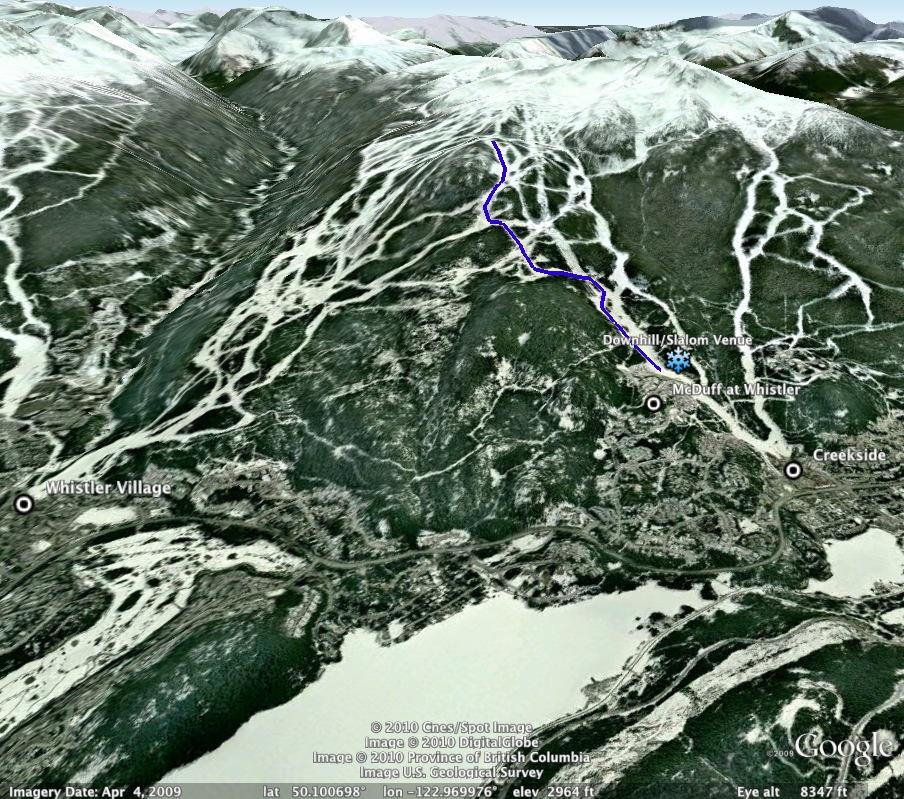
We decided to venture over to Whistler to see how the viewing “pods” on the men’s downhill course would be.  Great decision, we had an excellent view of the starting house and from that vantage point could see (having now measured it on Google Earth), about a quarter of the course.  I had cow bells along and we watched perhaps 30 starts.  Bode Miller had skied just before we arrived, but we did see Defago and Svindal, the gold and silver medalists.  We also ran into Seattle friends Doug and Robin and I depleted my case of cow bells by one.  Son Mark was at the next pod down the course and I’ll add some pictures (or visit my Facebook account in the meantime).

Day 5 was snowy with alpine skiing canceled.  Good day to stay in.

Day 6 started with the Women’s Downhill.  Tobae and Mark headed to viewing pods, while Daniel and I stayed in and alternated between live CTV and the view of the course on the front porch.  (Picture of Lindsey Vonn’s run taken by Daniel also to come).   NBC gets low marks for declaring the competition over a good 40 minutes before it was complete, much like they call presidential races.  Not to be outdone, CTV did the same thing 15 minutes early.

I met Tobae late afternoon in the village and we headed to the sliding center for doubles luge.  We started by placing ourselves right next to the course on the last turn, Turn 16, at the “2” in “Vancouver 2000”.  The nearby Jumbotron was essential, very much what is televised and comprehensible.   But the televised version of luge doesn’t begin to capture how fast they are moving.  I caught on to very rapid turn of head and neck necessary to track the sled over quite a distance, but we eventually moved to easier viewing spots, both up course where speeds are lower and well back in the finish area where we could just move our eyes to capture nearly all of Turn 16.  I don’t own photographic equipment that could possibly capture the action, except I suppose as artistic blurs.

I’ll post now so that Day 7 doesn’t begin and add pictures later.  And next topic CTV vs NBC.


Google Ski View

February 10, 2010

I happened onto a YouTube video of the Google Street View snowmobile in action at Whistler Blackcomb.  And so I fired up Google Earth to check out the products…

Google "Ski View"

This screen capture shows the down slope view along the Dave Murray Men’s Downhill course.  I chose this particular view for the shadow of the snowmobile and the trail of other “ski views” in the lower left.

I had imagined that I would find a full trail down the race course, but no such luck. I’m guessing much of the course was  too steep for travel of this top heavy snowmobile.

You can “spin” this embedded Google Map rendition of a nearby (up slope) ski view of the first pitch of the downhill:  Double Trouble.  (The snowmobile track heads up slope to the flat below the run “Orange Peel”

And here’s our neighborhood.  Our drive is just left of center.  The blue lamp post is now also the bus stop marker for the #101 Nordic Drive bus.  Turn the scene about 180 and the downhill grandstands are now straight ahead (but not yet built when this photo taken!) and dominate the view at the break in the slope of the road.


Olympics Day -3

February 9, 2010

While I was in Seattle, the Olympic Flame passed through Whistler.  I skied with my friend Rod today who had attended the event with his wife Lori and he was very impressed with the event itself and the feeling of “this is really happening”.  And indeed it is.

Rod and I had planned to get meet at 9:30 in Blackcomb Daylodge where we both have lockers.  Tobae was going to meet our friend Dan at the same time for coffee (Dan’s back is bothering him, so no skiing with him) and then join us later in the day.  And so to make this happen we both thought we should try to catch the 8:39 bus, as insurance that the buses were still not finely tuned.  No worries, right on time.  Dropped us at the bottom of the hill.  A route #2 in a couple of minutes, in the village at 8:53.  Time to kill.  We decided to stroll around for I hadn’t been in the village in quite awhile.  We stopped briefly at the “live” CTV broadcast center but nothing really happening so we moved on.  Near “Village Square” we turned the corner and I spotted Dan being interviewed by a CTV roving reporter.

Dan’s wife Catherine is an Olympic volunteer working in public relations (which is one of her past jobs).  She knows that Dan speaks his mind and she has been encouraging him to tone it down not to be overheard by anyone…he needs to be the “chamber of commerce”.  Unreported on my Day -10 entry, when we got off the bus on Day -11 a roving reporter had put a microphone in Dan’s face, asking him “how are the buses running”.  His reply: “The buses are all screwed up”.  So much for the advice from sainted wives.   We quickly rescued him this morning, but are still wondering what he had said during his five minute interview.  NBC Today is in the village at 4 a.m. tomorrow and we are encouraging Dan to do the weather thing.

On to skiing.  It was a blue sky day, unlimited visibility.  The condition of the snow was quite good; I’d call it (nearly) soft packed machine groomed.  *No* lift lines.  Rod and I did three runs then linked up with Tobae and headed to Symphony for some runs, back over to the front side for lunch, couple more runs, back over to Blackcomb via Peak to Peak, aka Restaurant to Restaurant, and skied back out to Blackcomb Daylodge.  Wonderful day.  Whistler is typically quite international compared to say Utah or Colorado.  But we are seeing so many unusual colors and fashions on the slopes and a fascinating mix of the typical and Olympic.  Most unusual today, the Cayman Island team.

End of day.  Skis to locker, Rod offered us a ride home.  But our access road, Nordic Drive, requires a permit until 4 p.m.  Turned out perfectly…the checkpoint was being put away as we passed.  But further up the hill the secondary checkpoint.  Rod was turned back even though we should have been able to turn left onto Taluswood Place, though not go straight ahead.  No worries, short walk, do it all the time with skis.  But this was worrying.  We have friends coming outside of permit hours and if they actually need a placard to continue further this will be a problem.  So I go back to the corner to inquire.  Talk with the Mountie that turned Rod back.  Need to talk with his superior.  Same question to him.  Need to talk with the VANOC supervisor.  Just in time for the VANOC presence at the checkpoint is leaving for the day leaving the RCMP in charge for the night.  I’m right.  We should have been able to continue to the left.  Only problem is that VANOC hasn’t told the security folk this is true.  So at least two of them now know it, but we expect continuing problems.


No Worries

February 9, 2010

I will soon post Olympics Day -3, but Tobae provides this keen insight into VANOC.  She was riding a lift last week with a young Aussie woman who works in the Westin Hotel.  VANOC has been coaching young Australians to not say “no worries”.  Don’t want worries on the radar, even if negated.  Apparently “no problem” is to be equally avoided.

The key according to the Australian woman:  worse thing one can do…tell us what not to do…won’t happen.

Our takeaway:  Aussie workers will smile when we (knowingly) say “no worries”.


Olympics, Day -9

February 4, 2010

Kentucky 3K Cow Bell

I need to be in Seattle for a few days, so drove home from Whistler after dinner this evening.

And along with mail and newspapers to take back, my case of cow bells!  Now we are really ready for the Olympics.

I have had a cow bell since 1984, a Treichlen #1 we bought in a hardware store in Zermatt.  Hangs in our kitchen, is never used.  Examining it tonight I see I should do a little maintenance of the metal.  Perhaps it would have been enough.

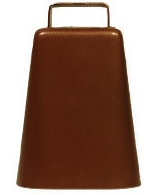
But many days there will be four of us.  And so I studied cow bells on the web.  I found lots of very fancy Swiss cow bells which would never be seen on a cow (or goat!).  Sites in Europe, sites in the US.  Are there any cow bells meant to be on cows?  To the rescue “Bell Outlet“, a division of Red Hill General Store.  While the Obama cow bell was tempting, the Kentucky series seemed more suited to the task.  And amazingly there were .wav files for each of the bells.  And so now I am the proud owner of a case of 3K Kentucky bells, just listen.


Olympics, Day -10

February 2, 2010

Whistler Bus Pass for February 2010

The countdown continues.

Even though public transportation went into its February mode, there was a conflict in print and web guidance on service on the route that now stops right at the end of our driveway would begin.  Would it start running Monday 2/1 or Wednesday 2/3?  So yesterday, Day -11, we punted and drove to our friend Dan’s, parked in his driveway, and took a bus from there.  Not much of a test, other than Dan learning that his usual bus doesn’t go to where he wants it to go during February.  Which led to a walk across the village and an observation.  We are going to be encountering much more cigarette smoke than usual.  Skiing was good and afterwards we found the locker we have rented in the village so we don’t have to carry skis back and forth.  All was well.  And on the way home we saw a Route 101-Nordic Drive bus!  They were running.

This morning we were planning on touring in the back country so it took some extra time for me to assemble all my gear…Tobae’s is always ready.  In principle there should be a bus every 15 minutes, roughly :09, :24, :39 and :54.  We walked out the front door at 8:36.  Tobae forgot her pack and had to go back and get it.  I’m stressing.  But I continued on hoping that I could get the driver to wait just a minute if the bus was on time.  Nothing to worry about.  There were three people waiting who had been there since 8:05.  Tobae arrived in just a minute or so.  A few minutes later, say 8:43, here one came.  We boarded.  The three scanned their passes.  I scanned my pass.  Tobae inserted her pass into the “insert currency here” slot.   It was gone into the lock box.

And so high praise for the other three (less so for me; I was mortified).  They were very patient while Tobae discussed the problem with the driver as the bus just sat there.  He radioed a supervisor.  He got instructions, which changed a couple of times for they had not armed him with things like transfers and special issue forms, but everything got written down.  (Leaping ahead Tobae was not the only unfortunate one today and there is a cottage industry at the transit office in verifying stories and handing out fresh passes; we think in due course her bus rides today will not set us back $38.50.)  With the paperwork done, the bus could now move.  The driver was friendly and talkative.  He had arrived from Montreal yesterday.  They gave him a bus and a map.  This was his first time on the route.  It was hard work for him (“it all looks the same, trees, snow, houses, no landmarks, no McDonald’s on the corner so you know to turn”).  We all knew what the route was suppose to be so we could help him.   We reached exactly the bus stop that I thought we would reach.  And we crossed the street to the next bus stop, but it was posted “Closed for February, Use Bus Stop on Highway”, so we walked 50 meters and joined a group of perhaps 15.  But coming up the highway was a Route #2 bus with a driver accustomed to old routes.  He bypassed us by turning right into the Creekside loop, aka London Lane.  But just a couple minutes later a Route #98 bus picked us up after lots of vigorous waving to flag him down.  And into the village.  Tobae swore that we were parking in Dan’s driveway everyday.

This afternoon went much better.  I added my backcountry skis to our locker, but Tobae decided she was hanging on to hers.  So I met her at the bus stop maybe 10 minutes after we reached the village.  Pretty quickly we were on a Route #1 Creekside Express and were delivered right next to Creekside Grocery.  Tobae ran up to buy a loaf of bread and another couple of cartons of ice cream (we have lots of ice cream in the freezer).  We went out to the highway bus stop and in just a couple of minutes a Route #101 bus to take us home.  Four aboard in all: driver, either supervisor or fellow route-learning driver, and the two of us.  About halfway home we caught up with the #101 ahead of us which I saw leave while Tobae was in the grocery store.  Just a few minutes and dropped  right at our door.  Maybe these buses will work?

For now, many drivers who are rookies in Whistler and with most buses having a supervisor on board to help teach the route.  Cries out for GPS in place of the supervisors, many of them new to Whistler as well.


Olympics, Day -13

January 30, 2010

Men's Downhill Course

About two weeks to go, but this is the last weekend of “normal” life in Whistler.

Changes have been evident already.  We don’t have our normal ski-in/ski-out access to the mountain for we are next to the race course, so we’ve been driving to Creekside to get on the gondola.  Otherwise it has been a quiet January.

But come Monday morning the Creekside gondola closes, all of the parking lots are taken over by VANOC and our lives on public transportation begins.   We’ve rented a locker in the village so we don’t have to carry skis back and forth, but what is normally a short walk to get going becomes two bus rides.  And while there are grocery stores further away accessible by car, bus is the only viable transport to the nearby Creekside Grocery and the adjacent BC Liquor Store.  We’ve been stocking up.  And on Thursday security of the venue steps up a notch and the vehicle checkpoint on the road up our hill is established.

Most of our complex is empty as is typical except for weekends and holidays.   Upstairs has been occupied for a couple of weeks…IT managers for VANOC.  Our next door neighbor, one of the few permanent residents, is off to Florida soon and his place will then be occupied by two members of the Canadian women’s alpine team.  Otherwise we don’t know what to expect.  What is certain is that the underground parking in our complex has 26 spaces for 16 units and we all have two parking permits but only one assigned space.   We’ve planted one car in one of the unassigned spaces and will then use the assigned space for comings and goings.